
Four Niger Delta States Receive ₦1.94 Trillion in Eight Months as Attention Turns to Infrastructure and Development
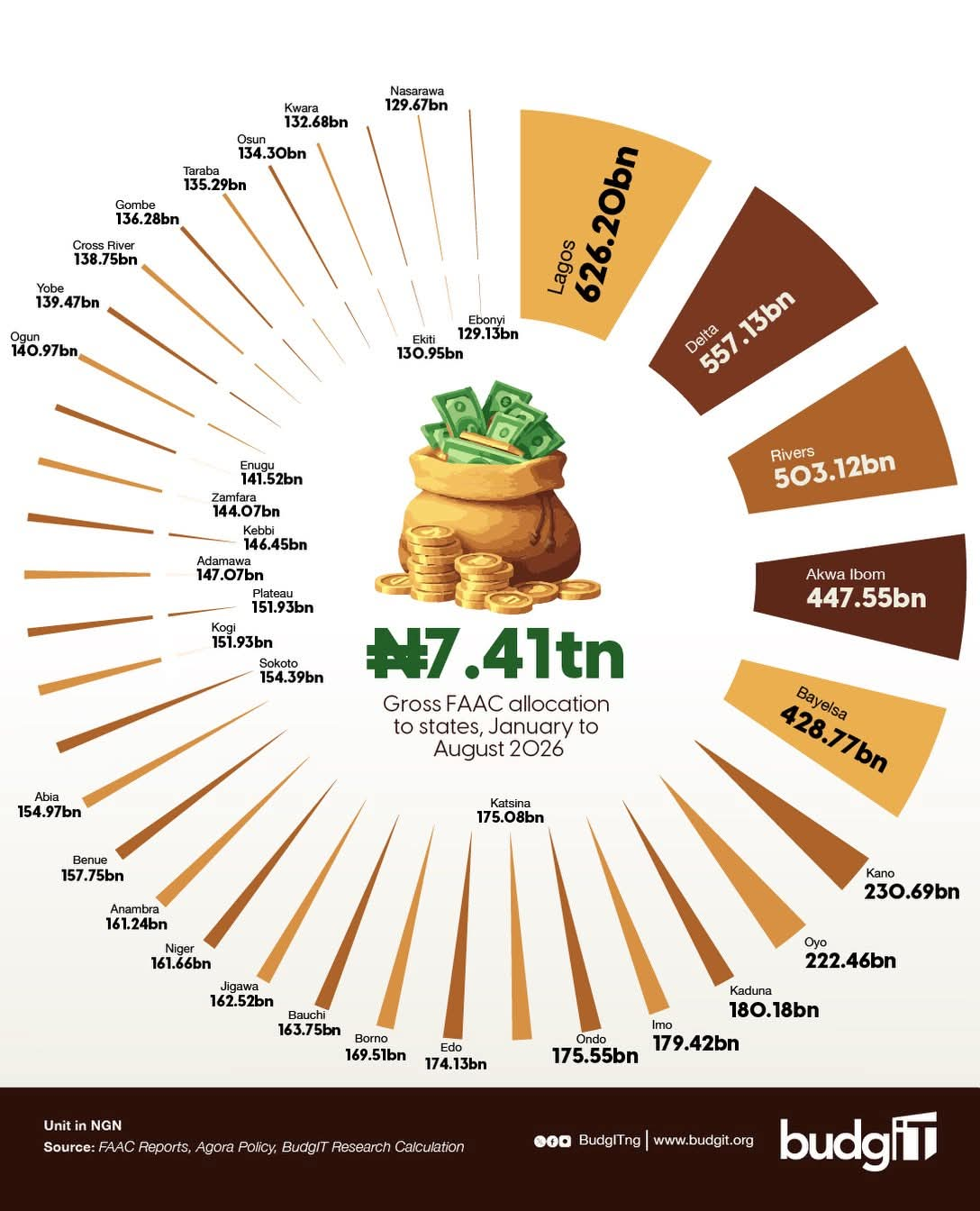
Nigeria’s 36 state governments received a combined gross allocation of ₦7.41 trillion from the Federation Account Allocation Committee (FAAC) between January and August 2026, according to figures released by BudgIT, a civic organisation promoting fiscal transparency and accountability.
The figures have brought renewed attention to the financial resources available to state governments and the need for greater transparency in how public funds are managed and utilised.
According to data published by BudgIT and obtained by GbaramatuVoice, Lagos State received the highest gross allocation of ₦626.20 billion, followed by Delta State with ₦557.13 billion and Rivers State with ₦503.12 billion.
Akwa Ibom State received ₦447.55 billion, while Bayelsa State recorded ₦428.77 billion, placing four oil-producing Niger Delta states among the five highest recipients nationwide.
Combined, Delta, Rivers, Akwa Ibom and Bayelsa accounted for approximately ₦1.94 trillion, representing more than a quarter of the total gross allocations to the 36 states during the eight-month period.
Other states with substantial allocations included Kano, which received ₦230.69 billion; Oyo, ₦222.46 billion; Kaduna, ₦180.18 billion; Imo, ₦179.42 billion; and Ondo, ₦175.55 billion.
At the lower end of the distribution, Ebonyi State recorded ₦129.13 billion, followed by Nasarawa with ₦129.67 billion and Ekiti with ₦130.95 billion.
The differences in allocations reflect Nigeria’s revenue-sharing arrangements, including statutory distributions, tax revenues and derivation payments to eligible oil-producing states.
Beyond Allocations: The Question of Accountability
While public attention frequently centres on the Federal Government’s budget, the figures highlight the considerable financial resources allocated to state administrations and the importance of scrutinising their expenditure.
With billions of naira allocated monthly, questions over the provision of infrastructure, healthcare, education, employment opportunities and other essential public services remain central to evaluating the performance of state governments.
The figures also underscore the oversight responsibilities of state Houses of Assembly, which are expected to scrutinise government expenditure and ensure that public resources are used in accordance with approved budgets and applicable laws.
However, gross FAAC allocations do not necessarily represent the amounts ultimately credited to state governments after deductions, nor do they establish how much was spent or whether funds were properly utilised.
Determining how effectively these resources have been managed requires examination of state budgets, budget implementation reports, procurement records and audited financial statements.
For residents of the Niger Delta, particularly Delta, Rivers, Akwa Ibom and Bayelsa states, the size of the allocations raises an important public-interest question: How much of these resources has translated into measurable improvements in roads, schools, hospitals, electricity, water supply and economic opportunities?
As Nigeria continues to debate public spending and economic development, attention is increasingly relevant not only at the federal level but also at the state level, where governors, legislatures and other accountability institutions have significant responsibilities for public finance.
Ultimately, the receipt of substantial public revenue is only one part of the accountability equation. How the resources are budgeted, spent and translated into services for citizens remains equally important.
Data Credit: BudgIT — based on FAAC reports, Agora Policy and BudgIT research calculations.